

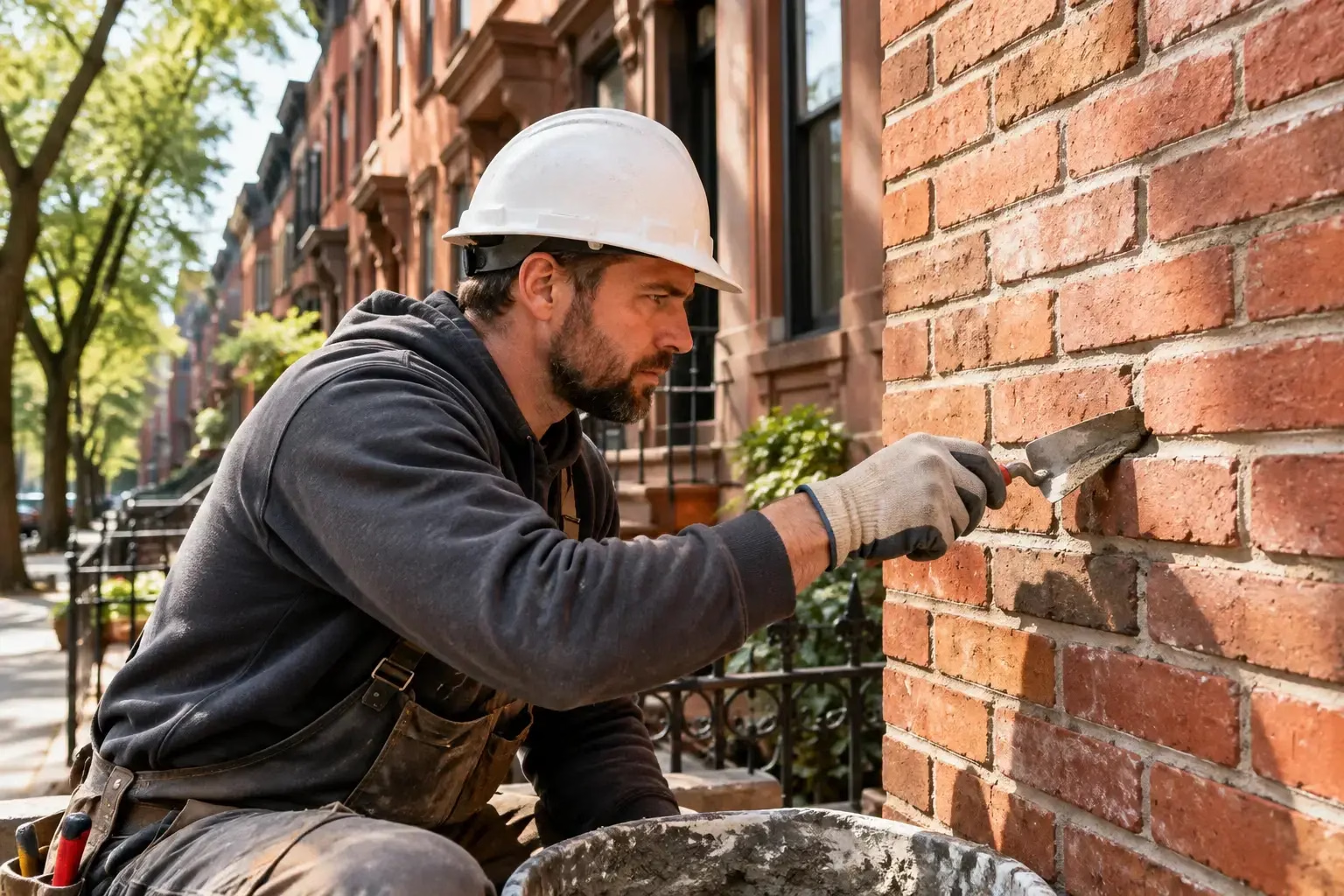
Brick repointing Park Slope property owners need is rarely about making a wall look newer. It is about stopping small mortar failures before rain reaches the interior of the masonry, bricks begin to loosen, or a façade repair becomes a much larger project. On a brownstone block, a few open joints can be easy to miss from the sidewalk. After a hard winter, they can become the entry point for water, staining, and freeze-thaw damage.
Park Slope has no shortage of beautiful older brick buildings, stoops, parapets, and rear additions. They also carry decades of patchwork repairs. The right repointing work respects the age of the building, matches the mortar properly, and addresses the actual source of deterioration instead of covering it with a cosmetic patch.
Brick Repointing Park Slope Property Owners Can Plan For
Repointing means removing failed mortar from brick joints and installing new mortar. It is not the same as smearing fresh mortar over cracks. Surface patching may look acceptable for a season, but it does not remove weak material underneath or create a durable bond along the joint.
A careful masonry contractor first checks whether the issue is limited to mortar joints or tied to a larger condition. Water may be entering through a failed coping stone, damaged flashing, roof edge, open parapet joint, cracked brownstone, or poor drainage. Repointing the wall without correcting the water source can lead to the same failure in the same area.
For a typical Park Slope townhouse, the scope may include a front façade, party-wall exposure, garden-level brickwork, chimney, parapet, rear extension, or foundation-area masonry. Each area takes a different amount of access, preparation, and protection. A visible first-floor repair is very different from work on a high parapet that needs scaffolding.
Signs Your Brickwork Should Be Inspected
Mortar does not need to be completely missing before it deserves attention. Property owners often call after seeing water indoors, but the exterior warning signs generally appear first. An inspection is worth scheduling when you notice:
- Mortar joints that are cracked, recessed, soft, sandy, or falling out
- Loose, spalled, or fractured bricks, especially near rooflines and parapets
- White powdery staining, known as efflorescence, on brick surfaces
- Rust stains, damp interior walls, peeling paint, or recurring water marks
- Bulging masonry, open cracks around lintels, or movement near window openings
Some of these signs point to routine maintenance. Others can indicate active water penetration or a façade safety concern. The difference matters. A clear, written estimate should identify the areas being repaired and explain whether brick replacement, waterproofing, flashing work, or structural repair is also needed.
Why Mortar Matching Matters on Older Brooklyn Buildings
One of the most common mistakes in masonry repair is using mortar that is too hard for the existing brick. Many older Brooklyn buildings were built with softer brick and lime-rich mortar. If a hard modern mortar is forced into those joints, the brick can become the weaker material. Moisture and movement then cause the brick face to crack or spall instead of allowing the mortar joint to do its job.
That is why mortar selection should not be treated as an afterthought. Color matters for appearance, especially on a front façade. Strength, texture, joint profile, and permeability matter for the life of the wall. The goal is not simply to make joints look new. It is to create a repair that works with the original masonry.
Proper preparation is equally important. Damaged mortar is removed to an appropriate depth without chipping surrounding brick. Joints are cleaned, dampened as needed, packed in controlled lifts, and finished to match the existing profile. Fresh mortar also needs proper curing conditions. Work rushed during unsuitable weather or left unprotected can fail early.
When Repointing Is Not Enough
Repointing is an effective repair when brick is sound and the mortar joints are the primary problem. It is not a cure-all. Bricks that have lost their faces, cracked lintels, failing parapet caps, deteriorated cornices, and active roof leaks need their own repairs as part of a coordinated scope.
This is especially true on brownstones where water travels. A roof leak can wet a parapet, migrate behind coping, damage brick below, and eventually show up as peeling paint on an upper-floor interior wall. Treating only the visible joint failure may waste money.
For larger buildings, owners and managers should also consider façade inspection obligations. New York City façade requirements can apply based on building height and conditions. A contractor can repair masonry, but a property owner should verify whether an architect, engineer, permit, or landmark review is required for the specific building and scope. In historic districts, visible façade changes may require approval before work begins.
Best Budget Construction in Brooklyn & NYC
Best Budget Construction approaches masonry repairs as part of the whole building, not as an isolated patch. A Park Slope repointing project may involve brick pointing, brick replacement, waterproofing, roof-edge repair, cornice restoration, stucco repair, sidewalk work, or interior repair caused by prior water entry. Having one experienced contractor coordinate related work can reduce handoffs, conflicting diagnoses, and repeat mobilization costs.
The first practical step is a site visit. Owners should expect the contractor to look at access, affected elevations, brick condition, mortar loss, drainage, rooflines, and any interior symptoms. For work that requires scaffolding, sidewalk protection, permits, or landmark coordination, those factors should be discussed before a final schedule is set.
Affordable work does not mean skipping preparation. It means identifying the correct repair early, defining the scope clearly, and avoiding the expensive cycle of temporary patches. The lowest number on an estimate can become the highest cost if the contractor ignores failing flashing, uses incompatible mortar, or leaves adjacent damaged brick in place.
License & Insurance credentials for all services
Exterior masonry work creates real jobsite responsibilities. Ask who will perform the work, how the area will be protected, what insurance documentation is available, and whether the contractor has experience with occupied NYC properties. This is particularly relevant where workers, pedestrians, neighbors, tenants, and parked vehicles are close to the repair area.
A dependable proposal should describe the repair area, materials, access needs, protection measures, cleanup, and exclusions. If the full extent of damage cannot be known until loose mortar is removed, that should be stated honestly. Older masonry often reveals hidden conditions, and transparent communication is better than a vague promise that ignores the possibility.
100% OSHA guidelines compliant
Safe execution protects the crew, the property, and the public. Repointing at height may require proper scaffolding, fall protection, controlled debris handling, and sidewalk safeguards. Dust control and careful removal also matter because aggressive grinding can damage aged brick and create unnecessary mess around an occupied home or business.
Homeowners should be cautious of anyone who proposes to repoint an entire façade with a quick surface coating or who cannot explain how work at height will be handled. A well-run project may take more planning, but it gives the repair a better chance of lasting and reduces disruption on a tight Brooklyn street.
Free Estimate Call (917) 674-9488
If mortar is opening, bricks are spalling, or water is appearing inside after rain, take clear photos and note where the problem occurs. Include whether the condition is at the front façade, rear wall, chimney, parapet, basement, or around a window. That information helps start a more useful conversation before the on-site inspection.
Do not wait for a small joint problem to become a loose-brick emergency. A timely inspection can help you choose between targeted repointing and a broader repair plan that protects the building, its appearance, and your budget.
