

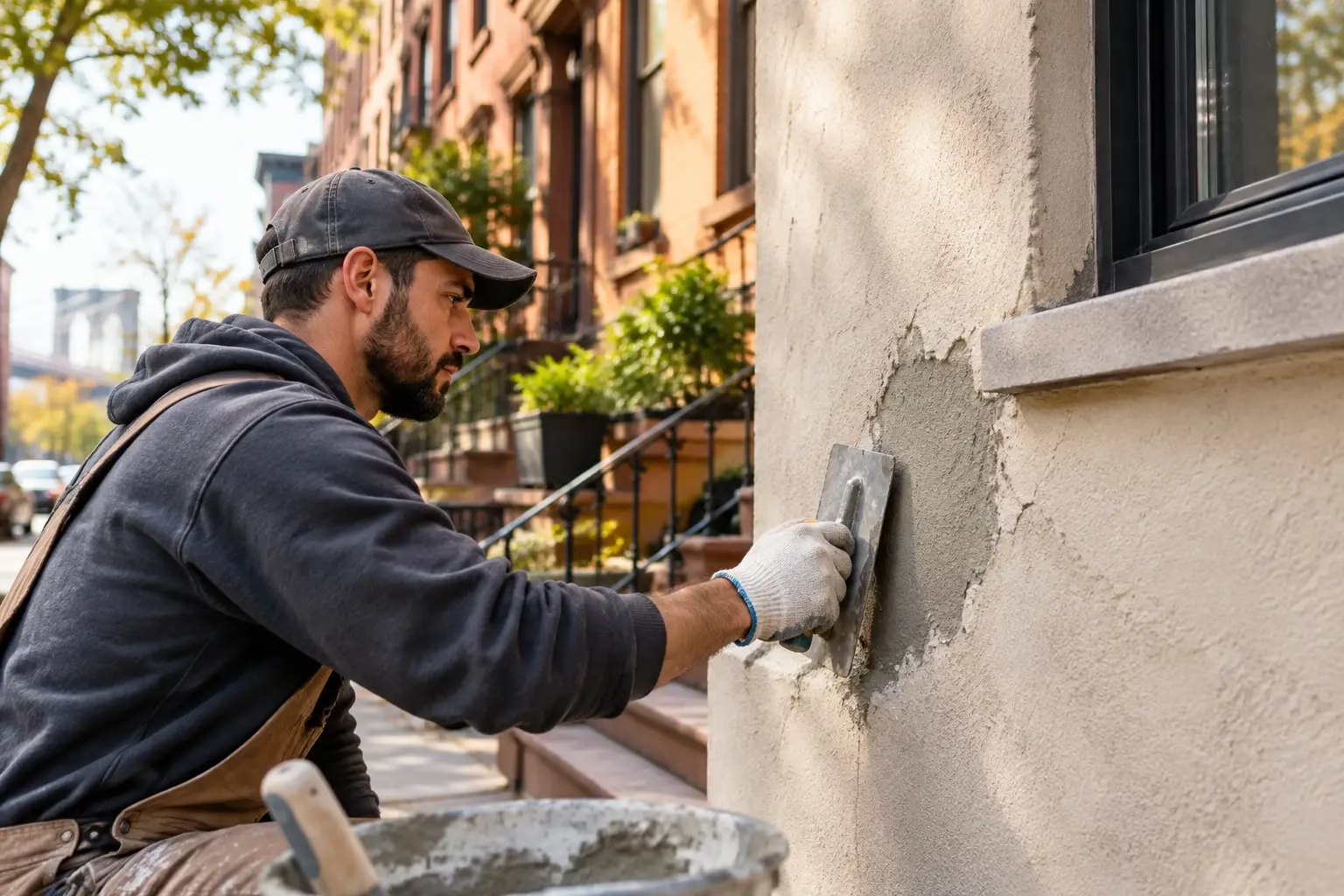
A hairline crack beside a Brooklyn brownstone window may look minor on Monday and become a water-entry problem after a hard week of rain. So, can stucco be repaired? In many cases, yes. Sound stucco can be patched, reinforced, re-coated, and blended to restore both protection and appearance. The key is finding out whether the damage is limited to the finish or whether moisture, movement, failed flashing, or deteriorated masonry is causing the problem underneath.
For NYC homeowners, landlords, and property managers, the cheapest repair is not always the smallest patch. A repair that closes a visible crack but leaves water entering behind the wall will fail again. A proper stucco repair starts with investigation, not a bucket of patching material.
Can Stucco Be Repaired Without Replacing the Whole Wall?
Stucco does not need to be removed from an entire facade every time it cracks or chips. Localized repairs are often effective when the surrounding material is firmly bonded, the wall behind it is dry, and there is no widespread structural movement. Small impact damage, isolated surface cracking, failed caulk at a penetration, and limited areas of delamination can usually be repaired without a complete replacement.
The answer changes when damage is widespread. If large sections sound hollow when tapped, the stucco is bulging, cracks run continuously across multiple stories, or staining keeps returning after patching, the system needs a deeper review. On older Brooklyn properties, the visible stucco finish can hide damaged brick, weakened mortar joints, corroded metal lath, or years of trapped moisture. In that situation, patching only the face is temporary work.
A contractor should inspect the full affected area, including window heads, parapets, coping stones, roof edges, downspouts, and wall penetrations. Water often enters above the place where damage appears. That is especially common on attached homes in Park Slope, Brooklyn Heights, and Bed-Stuy, where aging facades and roof transitions have been exposed to decades of freeze-thaw cycles.
What Stucco Damage Can Be Repaired?
Most repair decisions come down to the depth and cause of the failure. Surface-level flaws may need cleaning, crack preparation, a compatible patch, and a finish coat. Deeper damage requires removing loose material until a solid edge is reached, repairing the substrate, and rebuilding the stucco in layers.
Repairable issues commonly include:
- Hairline shrinkage cracks that are stable and not admitting water
- Chips, holes, and corner damage caused by impacts or aging
- Small areas of loose or hollow stucco around an otherwise sound wall
- Cracks around windows, doors, vents, and utility penetrations
- Worn or faded finish coats where the base coats remain intact
Some cracks deserve immediate attention. A diagonal crack starting at a window corner, a crack that has widened over time, or a split paired with interior water stains may indicate building movement or water damage. These are not conditions to cover with paint or caulk and hope for the best.
Why NYC Stucco Repairs Fail Too Soon
Poor surface preparation is one reason repairs fail, but it is rarely the only reason. New patch material needs a clean, stable, properly dampened surface and a compatible mix. If loose stucco remains at the edge of the patch, the repair can separate quickly. If the old wall is extremely dry, it can pull moisture out of the new material too fast and weaken curing.
The larger issue is usually moisture management. Water can enter through failed roof flashing, open mortar joints, cracked coping, missing sealant, or leaking gutters. It may travel behind stucco before showing up as a stain, blister, or crumbling spot several feet away. Before repair work begins, the source of water must be corrected.
Material compatibility matters on historic and older masonry buildings. A very hard cement-rich patch applied over softer, older materials can create stress and trap moisture. The result may be more cracking around the repair. The right approach depends on the existing wall assembly, not on a one-size-fits-all bag of repair mix.
The Right Way to Repair Stucco
A professional repair should preserve the wall, not simply make the problem less visible. First, damaged material is carefully removed back to sound stucco. The crew then examines the base beneath it. Depending on the condition, that may mean repairing masonry, replacing corroded lath, treating exposed metal, or correcting flashing before the patch is rebuilt.
Traditional stucco repairs are normally applied in multiple coats. The base or scratch coat creates a bond, the brown coat brings the area to plane, and the finish coat recreates the visible texture. Each layer needs appropriate curing time. Rushing the sequence can lead to shrinkage cracks, weak bonding, or an obvious patch line.
Texture and color matching are separate challenges. Even a technically correct repair may remain visible if the original finish has decades of weathering. Sand size, trowel technique, pigment, and the way the wall was previously painted all affect the final appearance. On a prominent street-facing facade, it can make sense to repair the damaged areas and then apply a compatible finish or coating across a larger section for a more uniform result.
When a Stucco Patch Is Not Enough
There are times when replacing a larger wall section is the more responsible and cost-effective option. Widespread hollow areas, repeated leaks, crumbling base material, extensive rust staining, and major cracking are warning signs. The same applies when a previous contractor has applied layer after layer of patch over failing material.
Full removal is more disruptive and costs more upfront, but it allows the wall behind the finish to be repaired correctly. It also gives the owner a chance to address brick pointing, waterproofing details, flashing, and other exterior conditions in one coordinated project. For property managers, that can reduce repeat service calls and prevent small facade issues from becoming emergency repairs.
Do not confuse painting with repair. Exterior paint may refresh a faded wall and help protect a sound finish, but it cannot reattach loose stucco or solve active water intrusion. Painting over damp or unstable stucco often traps the problem and creates peeling, blistering, or staining later.
License & Insurance credentials for all services
Facade and stucco work can involve ladders, scaffolding, falling material, public sidewalk protection, and close coordination with roofing, masonry, and waterproofing work. That is why property owners should verify that the contractor is properly licensed and insured for the work being performed. A clear written scope should explain what will be removed, how the underlying issue will be addressed, what finish is included, and what conditions could affect the final price.
Ask whether the estimate includes repairing the source of water damage or only the visible stucco. Ask how the contractor will protect windows, landscaping, neighboring properties, and pedestrian areas. These are practical questions, not paperwork. They help prevent surprises once work has started.
100% OSHA guidelines compliant Stucco Work
Safe execution matters as much as a clean finish. Exterior repairs in dense NYC neighborhoods require organized access, site protection, and trained crews who understand how to work around occupied homes, tenants, and active sidewalks. A job that is 100% OSHA guidelines compliant is better positioned to protect workers, residents, and the public while keeping the project moving on schedule.
At Best Budget Construction, stucco repairs are approached as part of the building envelope, not as a cosmetic afterthought. That means looking at the relationship between the stucco, masonry, roofline, drainage, windows, and sealants before recommending a repair. It is a practical way to protect your budget and avoid paying twice for the same problem.
Best Budget Construction in Brooklyn & NYC
Whether the issue is a small crack near a window or a larger area of loose facade material, get the condition checked before winter weather or another heavy rain exposes the wall further. Early repairs are usually simpler, safer, and less expensive than waiting for water damage to spread behind the finish.
Free Estimate Call (917) 674-9488
A clear inspection and written estimate can tell you whether your stucco needs a targeted patch, a broader restoration, masonry repair, waterproofing correction, or a combination of services. The best next step is not guessing from a crack. It is having the wall evaluated while the repair is still manageable.
